
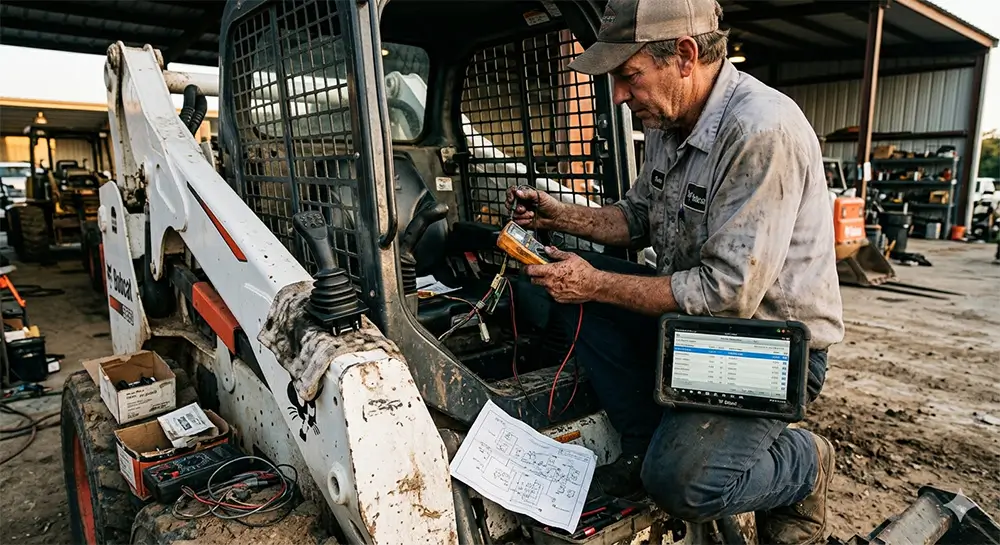
If your Bobcat joystick drifts on its own or stops responding, the cause is almost always one of four things: a center calibration that has slipped, moisture in the connector, a worn or failing Hall-effect sensor, or a cracked solder joint inside the joystick. Most of these are repairable. You rarely need a new OEM joystick to fix a machine that has started creeping or cutting out.
I want to walk through how we actually narrow it down on the bench, because the order you check things in matters. Operators send us joysticks all the time that just needed a recalibration, and on the flip side we see plenty that were “just acting up” and turned out to have a corroded board. Knowing which one you’re dealing with saves you money and downtime.
A bit of context first, since it changes how you should think about the problem.
Bobcat joysticks are electronic, not mechanical
On SJC (Selectable Joystick Control) machines, the joysticks are operate-by-wire. There is no cable or hydraulic line running from the stick to the pump. The joystick reads its own position with internal sensors and sends that signal to the controller, which then tells the hydraulics what to do. Bobcat covers how the system works on their own Selectable Joystick Controls page if you want the manufacturer’s overview.
Why this matters for diagnosis: when an electronic joystick “drifts,” it isn’t a sticky valve. It’s the stick reporting movement when it should be reading dead center. When it goes “unresponsive,” the signal isn’t reaching the controller. Both are electronics problems, and both usually live inside the joystick or its connector, not in the rest of the machine.
That’s also why swapping hydraulic parts to chase a drift never works. I’ve talked to operators who replaced a whole pump section before someone told them the joystick was the issue.
Start here: is it drift, or is it dead?
The two symptoms point in different directions, so figure out which you have before you touch anything.
Drift looks like the loader arm or drive creeping when your hand is off the stick, or an attachment function moving slightly on its own. The joystick is sending a small signal it shouldn’t be.
Unresponsive looks like one function (or all of them) doing nothing, or working intermittently when you wiggle the stick or it warms up. The signal is dropping out somewhere between the sensor and the controller.
Note whether it’s one axis or all of them, and whether it happens cold and then clears up once the machine has run for a while. A fault that disappears after warm-up almost always means moisture. Write that down before you call anyone. It’s the single most useful piece of information for whoever ends up diagnosing it.
The checklist, in the order we’d run it
1. Pull the fault codes first
Before you crawl under the cab, read the panel. The controller logs joystick and sensor faults, and the code tells you whether the machine even thinks the joystick is the problem. We keep a running reference of Bobcat service codes so you can look up what’s showing before you start pulling things apart. A code pointing at a drive or lift solenoid sends you somewhere completely different than a joystick sensor code.
2. Reseat and inspect the connector
Disconnect the joystick harness and look at the pins. You’re checking for green corrosion, bent pins, and any sign of water getting in. This is the number one thing we find on machines that work fine warm and act up cold, because condensation collects in the connector overnight and bridges contacts until it dries out.
Reseat it firmly and try the machine again. If a wiggle of the connector changes the behavior, you’ve found at least part of the problem.
3. Run the calibration
A surprising number of “drifting” joysticks are simply out of calibration. The controller has lost its idea of where center is, so it reads a resting stick as slightly deflected. Recalibrating resets the neutral point.
The catch is that calibration runs through Bobcat Service Analyzer software, which most owners don’t have. If you’re at a dealer or have a shop with the software, do this before assuming the joystick is bad. If you don’t, this is one reason a repair shop can sometimes fix a “broken” joystick in minutes.
4. Test one axis at a time
If a code and a recalibration haven’t sorted it, isolate the fault. Does only forward/back drift while side-to-side is fine? Is one button dead but the stick itself works? A single bad axis or button usually means one failed sensor or one cracked joint, not a whole dead joystick. That distinction is the difference between a quick board-level repair and a full rebuild.
5. Decide what’s actually wrong
By this point you can usually place the fault in one of these buckets:
A slipped calibration is the easy one. Recalibrate and you’re done.
A connector or harness problem means cleaning, drying, or repinning the connection. If moisture got far enough in, the internal board may already be corroding.
A failed Hall-effect sensor shows up as drift on one axis or a non-linear response where the function ramps unevenly. The sensor or its magnet has shifted or worn. This is a bench repair.
A cracked solder joint or damaged board is the classic “works when I wiggle it” intermittent. Vibration over thousands of hours fatigues the joints. This needs reflow or board-level rework under magnification, not a parts swap.
When it’s time to send it in
If you’ve checked codes, reseated the connector, recalibrated, and it still drifts or drops out, the joystick itself needs to come off the machine. That’s the point where guessing gets expensive and a bench gets faster.
Here’s what we do with one when it lands at our shop. Every joystick gets fully torn down, not patched. We clean and inspect the board, replace worn sensors, repair or reflow the joints, and then bench test it through its full range before it goes back out. We’ve been doing this on Bobcat electronics for over 18 years, and the units leave with a one-year warranty. A rebuilt joystick runs a fraction of a new OEM unit, and if you send us your old core you get credit toward the repair through our core credit program.
We handle both left-hand and right-hand Bobcat joysticks, including part numbers 6687883, 6687882, 6680181, 7102048, 7102049, 6697904, 6689920, and the matching kits. You can see the full joystick lineup or request a repair directly. Not sure which part you have or what’s wrong with it? Get in touch with the symptoms and your part number and we’ll tell you what we’re seeing.
One last thing: don’t ship a unit to us without an order number. Reach out first so we know it’s coming and can match it to your machine.